
Investing in Valencia: A Practical Guide for 2026
Valencia has spent the last few years quietly becoming one of the more talked-about property markets in Europe. If you're weighing whether to put money into investing in Valencia, here's what's true, what to check, and what to be honest with yourself about before you commit.
Why Valencia, and Why Now
Three things are converging at the same time.
Prices are moving, and buyers are noticing. The Comunidad Valenciana posted the strongest annual price growth of any region in Spain in Q2 2026, with the city of Valencia itself up over 16% year-on-year to roughly €2,786/m² — still well below Madrid, Barcelona, or most comparable Western European cities charging €5,000–€8,000/m². That gap between "obviously a good European city to live in" and "still comparatively affordable to buy in" is the whole thesis for a lot of Valencia real estate investment right now.
Demand isn't slowing down. Local buyers, international buyers, remote workers, and long-stay renters are all competing for the same limited supply of well-located, well-renovated homes. Valencia's combination of climate, direct flight connections, a genuine local culture, and a lower cost of living than Barcelona or Madrid keeps pulling people in — and keeps rental demand ahead of what the existing housing stock can comfortably absorb.
Supply is constrained. A lot of Valencia's most desirable housing stock sits in older buildings that need real renovation before they're rentable at a premium. That's a barrier for casual investors. It's also exactly where the opportunity sits for anyone willing to do the work, or partner with someone who already does.
None of this guarantees returns — no market does. But it's the honest case for why investing in Valencia is on more investors' radars in 2026 than it was three years ago.
Read more about the 60 Facts About Valencia That Explain Why The World Is Paying Attention.

The Two Ways to Invest in Valencia Property
1. Buy, renovate, and manage it yourself. This is the direct route: you buy a property, fund the renovation, furnish it, find tenants, and manage the ongoing relationship — or hire a local property manager to do it for you. You get full control and you keep 100% of the upside. You also carry 100% of the risk, the renovation headaches, and the time cost, especially if you're not living here.
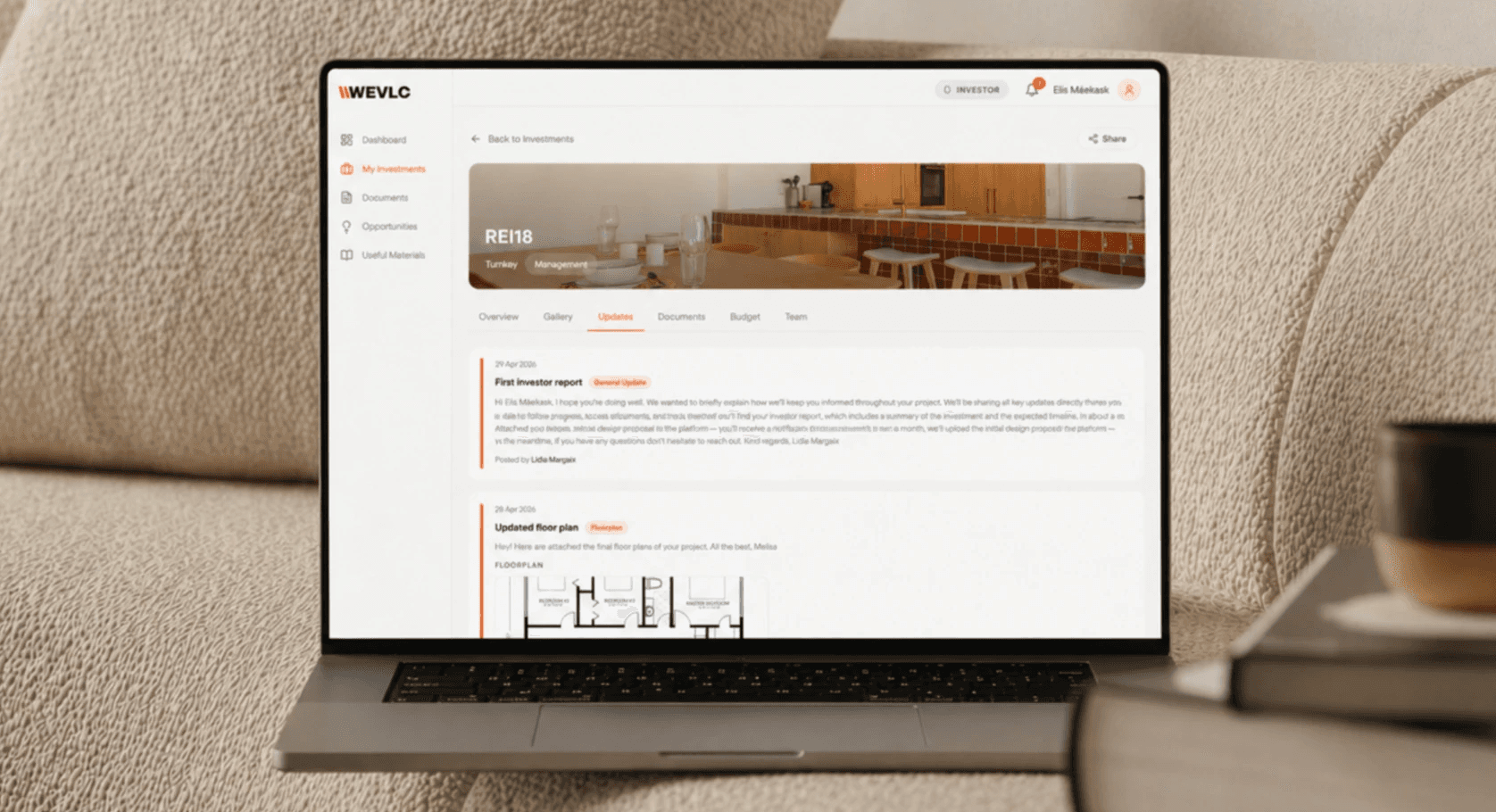
2. Invest through a managed platform. This is where a company like weVLC fits in. Instead of sourcing, renovating, and operating a property yourself, you invest into a project that's already been identified, bought, and renovated — and let an operator with local teams handle the tenant experience and day-to-day management. The weVLC platform gives investors quarterly reporting on live projects, a share of rental income, and a defined exit around year five. It trades some of the upside of doing it all yourself for a lot less of the operational weight.
Neither route is objectively better — it depends on how hands-on you want to be, how much local knowledge you already have, and how much time you're willing to spend on something that, done properly, behaves like a small business.
What Actually Affects Your Return
Whichever route you take, the same variables drive the outcome.
Purchase price versus true renovation cost is where most investors get surprised. The properties that look cheapest on paper are often the ones with the most expensive surprises once you open the walls. This is where local experience — knowing which neighbourhoods, which building types, which contractors — makes a measurable difference.
Location matters at a granular level. Valencia real estate isn't one market. A studio two minutes from the Turia gardens rents differently than one on a main road ten minutes further out, even at similar purchase prices.
Occupancy and tenant quality drive the actual return, not the headline rent. A property that sits empty for two months a year, or churns through tenants who don't pay reliably, underperforms one with steady, lower rent and low turnover.
Taxes and holding costs are easy to underestimate. Transfer tax in the Comunidad Valenciana currently sits at 9% on resale properties up to €1 million, reduced from 10% in June 2026, plus notary, registry, and legal fees typically adding another 2–4% on top of the purchase price. Ongoing costs include annual property tax and, for non-residents, Spanish non-resident income tax on rental income.
What to Ask Before You Commit — to Anyone
Is the operator's model, and its numbers, actually transparent? Ask what reporting looks like once you're in, not just what the pitch deck shows before you invest.
Who actually manages the renovation and the tenants? "We invest in real estate" and "we buy, renovate, and operate real estate" are very different businesses wearing the same words.
What's the realistic exit? Property is illiquid. Anyone glossing over how and when you actually get your capital back deserves a follow-up question, not a wire transfer.
What happens if a project underperforms? Every market has a down cycle in it somewhere. The operators worth trusting are the ones who'll tell you about the project that didn't go to plan, not just the ones that did.
The Honest Summary
Valencia's fundamentals — price growth, demand, constrained supply of quality renovated stock — are genuinely strong right now, and that's not a sales line, it's what the regional price data shows. But "the market is good" and "this specific investment is good" are two different claims, and only one of them is about your money.
If you'd rather see how a real, currently-live project works — numbers, renovation timeline, projected yield, and all — the weVLC investment platform is where that lives. Talk to the team or browse the open projects directly.
This article is general information, not financial or investment advice. Property investment carries risk, including the risk of loss. Always do independent due diligence, and speak to a licensed financial adviser before committing capital.
Investing in Valencia: A Practical Guide for 2026
Valencia has spent the last few years quietly becoming one of the more talked-about property markets in Europe. If you're weighing whether to put money into investing in Valencia, here's what's true, what to check, and what to be honest with yourself about before you commit.
Why Valencia, and Why Now
Three things are converging at the same time.
Prices are moving, and buyers are noticing. The Comunidad Valenciana posted the strongest annual price growth of any region in Spain in Q2 2026, with the city of Valencia itself up over 16% year-on-year to roughly €2,786/m² — still well below Madrid, Barcelona, or most comparable Western European cities charging €5,000–€8,000/m². That gap between "obviously a good European city to live in" and "still comparatively affordable to buy in" is the whole thesis for a lot of Valencia real estate investment right now.
Demand isn't slowing down. Local buyers, international buyers, remote workers, and long-stay renters are all competing for the same limited supply of well-located, well-renovated homes. Valencia's combination of climate, direct flight connections, a genuine local culture, and a lower cost of living than Barcelona or Madrid keeps pulling people in — and keeps rental demand ahead of what the existing housing stock can comfortably absorb.
Supply is constrained. A lot of Valencia's most desirable housing stock sits in older buildings that need real renovation before they're rentable at a premium. That's a barrier for casual investors. It's also exactly where the opportunity sits for anyone willing to do the work, or partner with someone who already does.
None of this guarantees returns — no market does. But it's the honest case for why investing in Valencia is on more investors' radars in 2026 than it was three years ago.
Read more about the 60 Facts About Valencia That Explain Why The World Is Paying Attention.
The Two Ways to Invest in Valencia Property
1. Buy, renovate, and manage it yourself. This is the direct route: you buy a property, fund the renovation, furnish it, find tenants, and manage the ongoing relationship — or hire a local property manager to do it for you. You get full control and you keep 100% of the upside. You also carry 100% of the risk, the renovation headaches, and the time cost, especially if you're not living here.
2. Invest through a managed platform. This is where a company like weVLC fits in. Instead of sourcing, renovating, and operating a property yourself, you invest into a project that's already been identified, bought, and renovated — and let an operator with local teams handle the tenant experience and day-to-day management. The weVLC platform gives investors quarterly reporting on live projects, a share of rental income, and a defined exit around year five. It trades some of the upside of doing it all yourself for a lot less of the operational weight.
Neither route is objectively better — it depends on how hands-on you want to be, how much local knowledge you already have, and how much time you're willing to spend on something that, done properly, behaves like a small business.
What Actually Affects Your Return
Whichever route you take, the same variables drive the outcome.
Purchase price versus true renovation cost is where most investors get surprised. The properties that look cheapest on paper are often the ones with the most expensive surprises once you open the walls. This is where local experience — knowing which neighbourhoods, which building types, which contractors — makes a measurable difference.
Location matters at a granular level. Valencia real estate isn't one market. A studio two minutes from the Turia gardens rents differently than one on a main road ten minutes further out, even at similar purchase prices.
Occupancy and tenant quality drive the actual return, not the headline rent. A property that sits empty for two months a year, or churns through tenants who don't pay reliably, underperforms one with steady, lower rent and low turnover.
Taxes and holding costs are easy to underestimate. Transfer tax in the Comunidad Valenciana currently sits at 9% on resale properties up to €1 million, reduced from 10% in June 2026, plus notary, registry, and legal fees typically adding another 2–4% on top of the purchase price. Ongoing costs include annual property tax and, for non-residents, Spanish non-resident income tax on rental income.
What to Ask Before You Commit — to Anyone
Is the operator's model, and its numbers, actually transparent? Ask what reporting looks like once you're in, not just what the pitch deck shows before you invest.
Who actually manages the renovation and the tenants? "We invest in real estate" and "we buy, renovate, and operate real estate" are very different businesses wearing the same words.
What's the realistic exit? Property is illiquid. Anyone glossing over how and when you actually get your capital back deserves a follow-up question, not a wire transfer.
What happens if a project underperforms? Every market has a down cycle in it somewhere. The operators worth trusting are the ones who'll tell you about the project that didn't go to plan, not just the ones that did.
The Honest Summary
Valencia's fundamentals — price growth, demand, constrained supply of quality renovated stock — are genuinely strong right now, and that's not a sales line, it's what the regional price data shows. But "the market is good" and "this specific investment is good" are two different claims, and only one of them is about your money.
If you'd rather see how a real, currently-live project works — numbers, renovation timeline, projected yield, and all — the weVLC investment platform is where that lives. Talk to the team or browse the open projects directly.
This article is general information, not financial or investment advice. Property investment carries risk, including the risk of loss. Always do independent due diligence, and speak to a licensed financial adviser before committing capital.
